
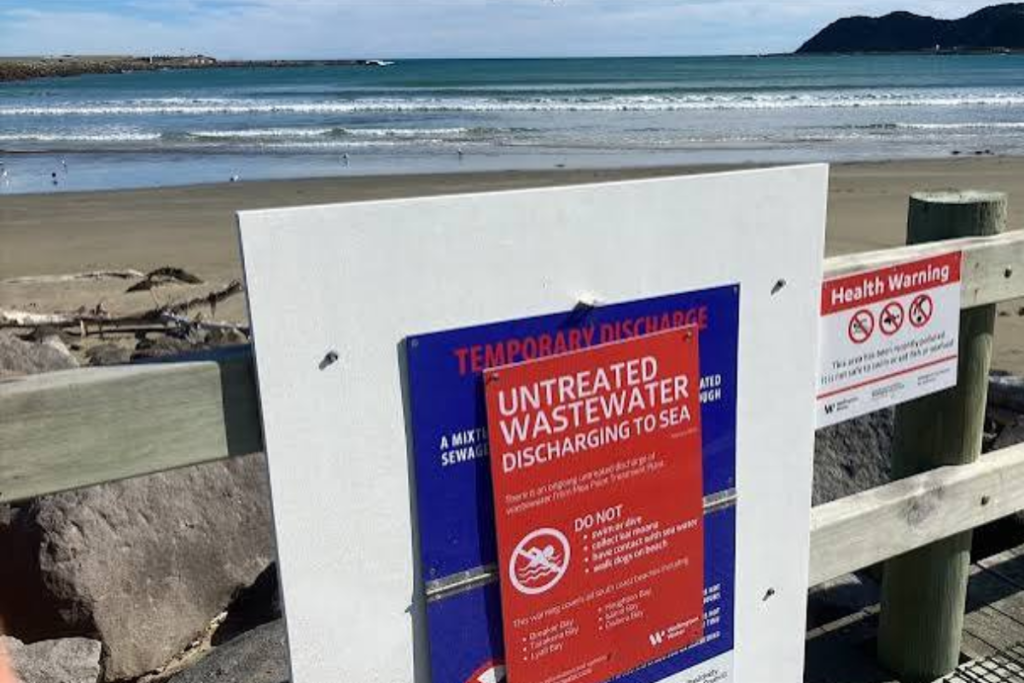



























































A Crown Review has found serious failures in governance, risk management and infrastructure oversight contributed to Wellington’s Moa Point wastewater disaster.
But while the review explains how the system failed, it does not identify any individual who has been held responsible for the failure of one of Wellington’s most critical public assets.
The Moa Point Wastewater Treatment Plant flooded on 4 February 2026 after years of accumulated risk left the facility operating with little room for error.
The Crown Review found the disaster was not caused by one mistake, but by a combination of ageing infrastructure, reduced treatment capacity, weak risk management and unclear accountability across the organisations responsible for the plant.
The review describes the incident as one of the most significant infrastructure failures Wellington has experienced in recent decades, affecting environmental outcomes, public confidence, essential service delivery and the operation of a critical public asset.
But the review leaves Wellington residents with a difficult question:
When warnings accumulated, risks were identified and a critical wastewater system failed, who was responsible for ensuring action was taken?
A system failure without a single person blamed
The Crown Review was not a personal blame investigation.
Its purpose was not to determine legal liability or conduct a technical fault investigation, but to identify systemic lessons that should inform the future management of wastewater infrastructure.
The result is a detailed explanation of how the system failed.
But it stops short of naming any individual executive, elected official or manager as personally responsible.
Instead, the review identifies failures across the organisations responsible for owning, managing and operating the plant.
The organisations responsible
At the time of the failure, responsibility for Moa Point was divided between several organisations.
Wellington City Council owned the plant and retained responsibility for stewardship, compliance and long-term performance.
Wellington Water managed the asset and was responsible for asset management advice, operational delivery and capital works programmes within council-approved budgets.
Veolia operated the treatment plant.
The Crown Review found this structure created a major accountability challenge.
It said the governance model separated the roles of asset owner, asset manager and operator, but did not align responsibility with decision-making authority.
In other words, responsibility was spread across the system.
But when responsibility is shared across multiple organisations, accountability can become difficult to trace.
Wellington Water leadership
Wellington Water was led by Chief Executive Pat Dougherty when the Moa Point plant failed on 4 February 2026.
The Crown Review examined Wellington Water’s role in managing the plant, but did not make findings against individual executives.
Instead, it focused on the organisation’s systems, processes and accountability arrangements.
The review found Wellington Water had identified risks, but those risks were not always rigorously attributed, quantified or linked to clear accountability mechanisms.
It also found Wellington Water had moved into a complicated role, operating as part asset manager, part coordinator and sometimes a “shadow operator”.
The review said this blurred accountability.
Council oversight criticised
The review was also critical of Wellington City Council’s role as asset owner.
It found council retained responsibility for stewardship, compliance and long-term performance of the plant.
However, it found council relied heavily on information provided by Wellington Water rather than independently testing whether risks were acceptable.
The review said there was little evidence council sought quantified risk exposure, residual risk statements or forward-looking assessments of potential consent breaches.
It classified council’s governance approach as:
“certifying, with elements of passive”.
The review’s criticism was not that council interfered too much.
It was that council did not challenge enough.
Known risks accumulated
The accountability question becomes more difficult because the review found warning signs existed before the disaster.
Moa Point was already operating under significant constraints.
One of the plant’s two ultraviolet disinfection units was offline for replacement, reducing treatment capacity and increasing reliance on bypass systems during high rainfall.
Treatment capacity was effectively reduced from about 3,000 litres per second to around 1,500 litres per second during the UV renewal project.
The review found earlier events had shown similar warning indicators, including abnormal UV system signals, but the vulnerability was not fully understood or resolved.
Concerns were also raised during planning for the renewal project about bypass capacity and operational risks.
The review found those concerns were not clearly resolved through structured processes for ownership, escalation and decision-making.
The unanswered question
The Crown Review explains how Moa Point failed.
It identifies the infrastructure problems, the governance weaknesses and the risk management failures.
It recommends changes to prevent the same problems happening again.
But the question remains:
When a critical public asset fails after years of accumulated risk, what does accountability look like?
The review found responsibility was spread across organisations.
But organisations are led by people.
Decisions about funding, risk, monitoring and escalation are made by boards, executives, managers and elected leaders.
The public question is not whether one person caused the Moa Point disaster.
The review does not say that.
The question is whether the people responsible for overseeing one of Wellington’s most important public assets were held accountable when the risks became too great.
The Crown Review has explained the system failure.
The remaining question for Wellington is whether system reform alone is enough.
