
Te Ngākau Civic Square will reopen to the public from Saturday 14 March, marking a major milestone in the capital’s civic precinct redevelopment and the return of a central gathering space shaped by history, culture and nature.
The revitalised Te Ngākau Civic Square features new landscaping, planting and design elements inspired by the area’s original coastal environment and the awa that once flowed through it to the harbour.
The reopening coincides with the return of the central library, Te Matapihi ki te Ao Nui, restoring a key link between the city and Te Whanganui-a-Tara harbour. The square has long served as a focal point for community events, celebrations and public demonstrations.
The redesign is a collaboration between mana whenua design lead Tihei, landscape architects Warren and Mahoney, Wellington City Council and construction partner LT McGuinness. It aims to bring the essence of te taiao, the natural living environment, back into the urban centre.
Rangi Kipa of Tihei said the design reflects both the physical and historical flow of the site.
“The square’s design is guided by the flow of awa that once ran through the area, and therefore the flow of history as we return the mauri of te taiao to the precinct,” he said.
Water features play a central role, echoing the natural ebb and flow of the former streams. Their movement and height can respond to tides, weather and activity in the square, while shallow pools reference the site’s intertidal past.
Landscape architect Michael Hawes said the features are designed to reconnect people with natural cycles.
“As water gathers and dries in the subtle pools, there’s a reminder of the former foreshore and the cycles of tide, rain and evaporation,” he said.
The square also includes carved elements and seating inspired by coastal forms, native planting suited to the location, and permeable paving that allows greenery to grow through, softening the urban environment over time.
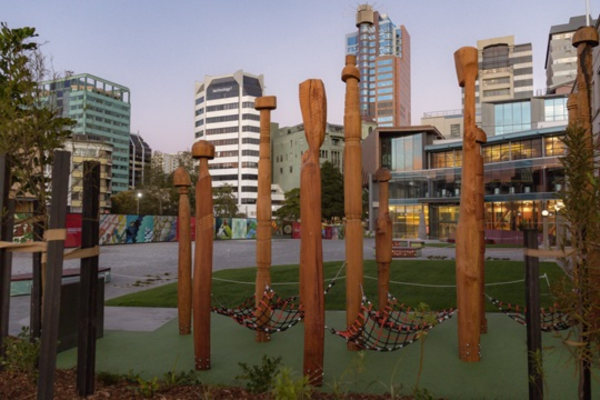
A standout feature is a series of large carved tōtara sculptures known as tumu, created by Kipa. Standing between 3 and 5 metres tall, the works are designed to resemble human silhouettes and act as guardians of the space.
Kipa described them as “sentinel beings” that bring visibility to Māori narratives within the civic landscape.
As surrounding cultural and civic spaces gradually reopen, city leaders expect the renewed square to play a key role in revitalising the precinct and encouraging people back into the heart of Wellington.
The redevelopment blends contemporary urban design with deep cultural storytelling, offering a space that reflects both the city’s past and its evolving identity.
