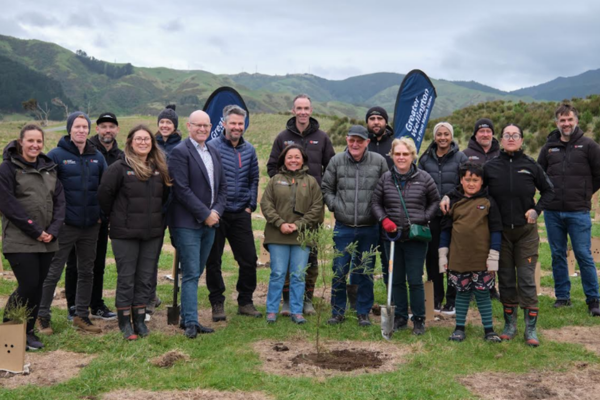
























































One million native trees have now been planted across Greater Wellington regional parks through the council’s Recloaking Papatūānuku programme.
The millionth tree was planted at Queen Elizabeth Park during a live TVNZ Breakfast broadcast, marking a major milestone in efforts to restore former grazing land.
Greater Wellington chair Daran Ponter said the programme showed what could be achieved through partnerships with mana whenua, community groups, volunteers and local businesses.
“A million native trees is a special milestone for our region, and a powerful reminder of what we can achieve when we come together for te taiao,” Cr Ponter said.
“Recloaking Papatūānuku is about much more than planting trees. It’s about restoring the health of our regional parks, improving habitat for native species, enhancing the wellbeing of our waterways, and giving communities a practical way to care for the whenua that sustains us.”
Since 2019, about 420 hectares of the roughly 2,000 hectares of former grazing land in regional parks has been replanted.
Greater Wellington expects about 200,000 native trees to be planted each winter in the coming years.
Parks restoration project lead Kellie Benner said the programme relied on a wide network of nurseries, contractors and community groups.
Plants are sourced from nurseries including the Rimutaka Prison nursery in Trentham and iwi-run nurseries such as Otaraua in Kāpiti.
“Park visitors can see the transition for themselves,” Benner said.
“In just a few short years, the land has changed from pasture with very little biodiversity to regenerating native areas that are full of life.”
Greater Wellington manages eight regional parks covering 33,000 hectares. Much of the land was historically converted to farmland, reducing biodiversity and displacing native wildlife.
Director of delivery Jack Mace said restoring the parks also improved streams, wetlands, rivers and inlets.
Planting along waterways helped create habitat for fish, reduce erosion and limit sediment and nutrients entering the water, he said.
Emissions from grazing in regional parks have nearly halved since 2019 as stock has gradually been removed from restoration areas.
Greater Wellington also runs community planting days during winter. Upcoming community planting days will be held at Battle Hill Farm Forest Park at 1pm on Sunday 26 July and Edgewater Park in Waikanae at 10.30am on Thursday 30 July. Event details are available on the Greater Wellington website.
